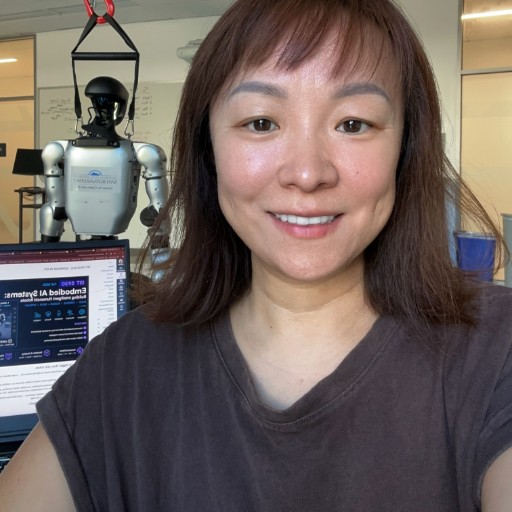
Yutong Liu

Research & Engineering Portfolio

Yutong Liu

Embodied AI Engineer & Robotics Researcher

Yutong Liu is an Adjunct Faculty member in the Information Systems and Technology (IST) Program at California State University, San Bernardino.

She specializes in Embodied AI, combining robotics, machine learning, computer vision, motion capture, digital humans, and immersive technologies to build intelligent systems that can perceive, communicate, and learn from the physical world.

At CSUSB, she serves as the Lead of the Motion Capture Studio, supporting interdisciplinary research and teaching in human movement analysis, virtual production, digital humans, and robotics.

Her experience includes:

  • Lead, CSUSB Motion Capture Studio
  • 5+ years of Unreal Engine 5 and digital human development
  • Embodied AI and humanoid robotics
  • Machine learning and computer vision
  • Motion capture and robot learning
  • AI-powered virtual humans and simulation

In her courses, students learn by building real AI applications—from digital humans to intelligent robots—using modern industry tools and research platforms. No robotics experience is required—just curiosity and a willingness to learn.

Projects

SB01 — Unitree G1 Conversation

A humanoid robot you can hold a real conversation with. SB01 turns the Unitree G1 into an assistant that listens, reasons with Claude, answers out loud and gestures as it speaks. It runs live on the robot in the lab, in the classroom and at public demos.

  • Complete voice pipeline: Whisper speech recognition, streamed Claude replies and text-to-speech played through the robot's own speaker
  • Recognizes returning visitors by face and remembers past conversations, but only after asking their permission
  • Answers questions from a local knowledge base of course materials and papers; every arm gesture passes through a joint-limit and speed safety filter
Embodied AILLMsRobot Learning

QTM Teleop G1

Move in the motion-capture studio and the G1 moves with you. A live pipeline streams a performer's skeleton from Qualisys, maps it onto the robot's 29 joints and checks every command for safety before it reaches the hardware.

  • About 5 ms median motion-capture latency; a 24-segment skeleton retargeted with GMR inverse kinematics at 100 Hz
  • Safety layer built in from the start: joint-limit clamping, speed limits, automatic hold on stale or invalid data, and a MuJoCo dry-run mode before any hardware run
  • Records each session as a dataset for teaching robots by demonstration, and converts recorded FBX sessions offline. Validated on live motion-capture data in simulation; robot trials are next
TeleoperationMotion CaptureRobot Learning

G1 Text-to-Motion

Describe a movement in plain English and the G1 performs it. This project connects TEXEDO, a recent text-to-motion model, to NVIDIA's GR00T SONIC whole-body controller, so every generated motion is tested by a physics-based controller in simulation first.

  • Interactive loop: type a prompt, generate candidates, keep the best, and watch the result in MuJoCo within seconds
  • Joint-activity analysis shows which of the robot's 29 joints each prompt actually drives
  • Approved motions are saved as a reusable library, with the prompt and generation settings recorded so every result can be reproduced
Motion GenerationSimulation

G1 Kendama — Big-Cup Catch

Can a humanoid play kendama? The G1 swings the ball up and catches it in the big cup, a fast, precise skill where prediction, planning and control all have to work together.

  • Open-loop swing-up followed by a closed-loop catch that predicts where the ball will land, built on published robotics research (Bujarbaruah et al. 2020; Nemec & Ude 2011)
  • Tuned by CEM search with the full arm dynamics and the robot's real joint-speed limits in the loop
  • 30/30 catches with 3% parameter jitter and up to 5 mm of camera noise, holding the ken in a custom 3D-printed fist designed for the G1
SimulationRobot Learning

More projects in perception and simulation are in progress and will be added here.

Teaching

IST 5930: Embodied AI Systems

CSUSB · Fall 2026

Students build a working AI system on the Unitree G1 humanoid robot — a real machine that talks, recognizes faces, and mimics human motion. Topics include publish-subscribe robot networking, LLM-driven voice pipelines, motion capture and retargeting, and security and privacy in embodied AI. Prerequisite: some Python; no robotics background assumed.

Publications

Integrating Large Language Models into Robotic Autonomy: A Review of Motion, Voice, and Training Pipelines

AI (MDPI), Vol. 6, Issue 7, Article 158 — July 2025

Yutong Liu, Qingquan Sun, Dhruvi Rajeshkumar Kapadia — California State University, San Bernardino